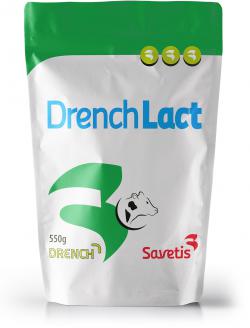
00 33 296 873 000


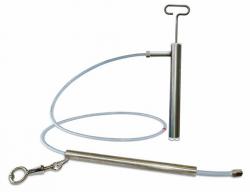
Das Drenchbesteck von SAVETIS ist ein Qualitätswerkzeug, das in Frankreich hergestellt wird und entsprechend hohe Zuverlässigkeit im täglichen Einsatz bietet.



Ergänzungsfuttermittel für Milch- und Mutterkühe. DrenchUp ist eine komplette Formel, die auf die spezifischen Bedürfnisse der festliegenden Kuh unmittelbar nach der Kalbung abgestimmt ist. In einem einzigen Beutel kombiniert sie bioverfügbare Mengenelemente, appetitanregende Pflanzen, Nährstoffe zur Unterstützung der Leber und B-Vitamine für einen guten Start in die Laktation.
Rund um die Kalbung weist die festliegende Kuh häufig mehrere Defizite gleichzeitig auf: an Mineralstoffen, an Appetit und an Energie. DrenchUp setzt an vier sich ergänzenden Punkten an, in einer einzigen Formel und ohne dass Produkte kombiniert werden müssen.
Zufuhr bioverfügbarer Mengenelemente und Unterstützung des Calcium-Phosphor-Stoffwechsels (1 bis 12)<
1 Beutel in 20 bis 30 Liter lauwarmem Wasser (30 °C) auflösen, gut verrühren und die Lösung mit einem geeigneten Drench-Gerät oral eingeben. Bei Bedarf nach 24 Stunden wiederholen.
Empfehlungen
Bei einer festliegenden Kuh stets darauf achten, dass sie sich in Brustlage befindet. Das Drenchen wird bei Kühen in Seitenlage nicht empfohlen. Vor der Anwendung wird empfohlen, einen Tierarzt zu Rate zu ziehen. Die Anwendung dieses Produkts ist im Bestandsbuch zu dokumentieren. Nach dem Öffnen des Beutels sofort verwenden.
Präsentation
Beutel zu 850 g, im Karton zu 12 Beuteln.
Ausschließlich über Ihren Tierarzt erhältlich.
Literaturverzeichnis
(1) Jarrett J.P., Taylor M.S. et al. (2012), Effects of dietary calcium and stage of lactation on potassium balance in lactating Holstein cows through 20 weeks, The Professional Animal Scientist 28: 502-506.
(2) Goff J.P. (2004), Macromineral disorders of the transition cow, Vet. Clin. North Am. Food Anim. Pract. 20(3): 471-494.
(3) Rivoire et Commun (2014), Drenchage des vaches laitières dans la prévention et le traitement de l'hypocalcémie au vêlage, Bulletin des GTV n° 75, 81-86.
(4) Goff J.P. (1999), Treatment of calcium, phosphorus and magnesium balance disorders, Vet. Clin. North Am. Food Anim. Pract. 15(3): 619-639.
(5) Constable P. (2003), Fluid and electrolyte therapy in ruminants, Vet. Clin. North Am. Food Anim. Pract. 19: 557-597.
(6) Idink M.J., Grünberg W. (2015), Enteral administration of monosodium phosphate, monopotassium phosphate and monocalcium phosphate for the treatment of hypophosphataemia in lactating dairy cattle, Veterinary Record, doi: 10.1136/vr.102847.
(7) Idink M.J., Grünberg W. (2018), Suitability of oral administration of monosodium phosphate, disodium phosphate, and magnesium phosphate for the rapid correction of hypophosphatemia in cattle, Journal of Veterinary Internal Medicine 32: 1253-1258.
(8) Grünberg W. et al. (2013), Kinetics of phosphate absorption in lactating dairy cows after enteral administration of sodium phosphate or calcium phosphate salts, British Journal of Nutrition 110: 1012-1023.
(9) Horst R.L., Goff J.P., Gill S., Dallorso M.E., Pawlak E. (2003), Using Solanum glaucophyllum as a source of 1,25-dihydroxyvitamin D to prevent hypocalcemia in dairy cows, Acta Vet. Scand. Suppl. 98.
(10) European Food Safety Authority (2015), Scientific Opinion on the safety of Solanum glaucophyllum standardised leaves as feed material, EFSA Journal 13(1): 3967.
(11) Ishii J., Uramoto A., Nagao Y., Goto H. (2015), Feeding Solanum glaucophyllum to preparturient multiparous cows prevents postparturient hypocalcemia, Anim. Sci. J. 86(10): 869-877.
(12) Bachmann H., Lanz M., Kehrle S., Bittner W., Toggenburger A., Mathis G.A., Rambeck W. (2017), Effects of a sustained release formulation of 1,25-dihydroxyvitamin D3-glycosides for milk fever prevention on serum 1,25-dihydroxyvitamin D3, calcium and phosphorus in dairy cows, J. Steroid Biochem. Mol. Biol. 173: 301-307.
(13) Anton R., Wichtl M. (2003), Plantes thérapeutiques, Éd. Tec & Doc.
(14) Bruneton J. (2016), Pharmacognosie, phytochimie, plantes médicinales, Lavoisier Tec & Doc.
(15) Zom et al. (2011), Effect of rumen-protected choline on performance, blood metabolites, and hepatic triacylglycerols of periparturient dairy cattle, J. Dairy Sci. 94(8): 4016-4027.
(16) Grummer R.R. (2008), Nutritional and management strategies for the prevention of fatty liver in dairy cattle, Vet. J. 176(1): 10-20.
(17) Guretzky et al. (2006), Lipid metabolite profiles and milk production for Holstein and Jersey cows fed rumen-protected choline during the periparturient period, J. Dairy Sci. 89(1): 188-200.
(18) Durand et al. (1995), Stéatose hépatique : mécanismes et traitements nutritionnels chez la vache laitière, Le Point Vétérinaire 27 (numéro spécial « Maladies métaboliques des ruminants »), 741-748.
(19) Hurley W.L., Doane R.M. (1989), Recent developments in the roles of vitamins and minerals in reproduction, J. Dairy Sci. 72: 784-804.
(20) Santschi D.E., Berthiaume R., Matte J.J., Mustafa A.F., Girard C.L. (2005), Fate of supplementary B-vitamins in the gastrointestinal tract of dairy cows, J. Dairy Sci. 88: 2043-2054.
(21) Girard C.L., Matte J.J. (2006), Impact of B-vitamin supply on major metabolic pathways of lactating dairy cows, Canadian Journal of Animal Science 86: 213-220.
(22) Moallem U., Lehrer H., Livshitz L., Zachut M., Yakoby S. (2009), The effects of live yeast supplementation to dairy cows during the hot season on production, feed efficiency and digestibility, J. Dairy Sci. 92: 343-351.
Das Drenchbesteck von SAVETIS ist ein Qualitätswerkzeug, das in Frankreich hergestellt wird und entsprechend hohe Zuverlässigkeit im täglichen Einsatz bietet.