00 33 296 873 000


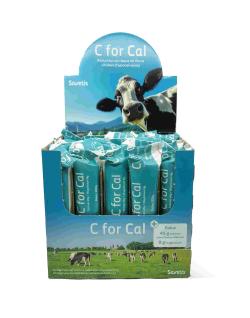
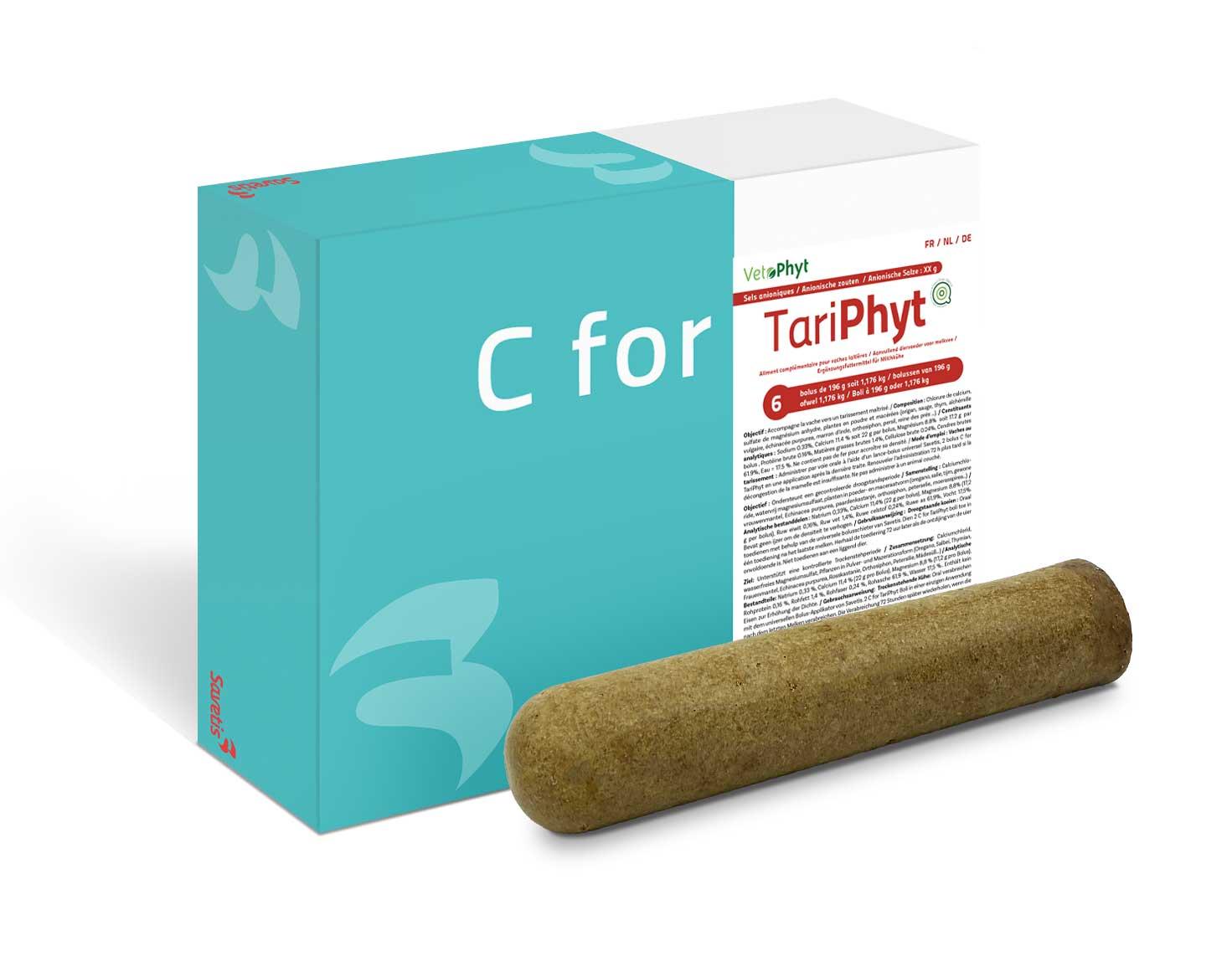
C for TariPhyt – Bolus met anionische zouten en planten ter ondersteuning van het droogzetten
Aanbevolen voor
Aanvullend diervoeder voor melkkoeien. C for TariPhyt begeleidt de koe naar een beheerste en fysiologische droogstand. Het combineert anionische zouten, die het geleidelijk stoppen van de lactatie vergemakkelijken, met een selectie van planten die bijdragen aan het comfort van de uier en het evenwicht van het organisme aan het einde van de lactatie.
Productomschrijving
Het stoppen met melken is een gevoelige fase, zeker bij koeien die nog veel melk produceren. Een te volle uier is oncomfortabel voor het dier en vertraagt de involutie van de uier. C for TariPhyt werkt op drie complementaire assen.
Begeleiding van het geleidelijk stoppen van de lactatie (1,2,3)
Elke bolus levert 164 g anionische zouten, goed voor een DCAB van -2 460 mEq.
Samenstelling
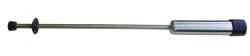
Dien bij het droogzetten 2 bolussen in één keer toe, direct na de laatste melkbeurt, met behulp van een universele Savetis-bolusingever. Herhaal de toediening indien nodig 72 uur later. Bolus met een diameter van 35 mm, valt binnen 2 uur uiteen.
Aanbevelingen
Vraag vóór gebruik advies aan een dierenarts. Niet toedienen aan een liggend dier. Bewaren op een koele en droge plaats, tussen 15 en 25 °C. Na opening snel gebruiken. Houdbaarheid: 24 maanden.
Presentatie
Bolus van 196 g, in een doosje met 6 bolussen.
Uitsluitend verkrijgbaar via uw dierenarts.
Literatuurverwijzingen
(1) Maynou et al. (2018), Effects of oral administration of acidogenic boluses at dry-off on performance and behavior of dairy cattle, J. Dairy Sci. 101: 11342-11353.
(2) Florentino et al. (2024), Randomized clinical trial evaluating the effects of administration of acidogenic boluses at dry-off on udder health, milk yield, and herd removal, J. Dairy Sci. 107: 3899-3915.
(3) Brodin (2020), Étude des effets de l'administration de PRC-19 sur la diminution de la production laitière au tarissement chez des vaches laitières : éléments de bibliographie et de protocole.
(4) Ouvrier-Buffet (2017), Les plantes diurétiques à l'officine, Sciences pharmaceutiques, Dumas-01564248.
(5) Labre (2007), Phytothérapie & aromathérapie chez les ruminants et le cheval – Médecines naturelles en élevage, tome 2, Éditions Femenvet.
(6) Ottillinger & Greeske (2001), Rational therapy of chronic venous insufficiency – chances and limits of the therapeutic use of horse-chestnut seeds extract, BMC Cardiovasc. Disord. 1: 1-5.
(7) Felixsson et al. (2010), Horse chestnut extract contracts bovine vessels and affects human platelet aggregation through 5-HT2A receptors: an in vitro study, Phytother. Res. 24: 1297-1301.
(8) Arnould et al. (1996), Effect of aescine on hypoxia-induced activation of human endothelial cells, Eur. J. Pharmacol. 315: 227-233.
(9) Facino et al. (1995), Anti-elastase and anti-hyaluronidase activities of saponins and sapogenins from Hedera helix, Aesculus hippocastanum, and Ruscus aculeatus: factors contributing to their efficacy in the treatment of venous insufficiency, Arch. Pharm. 328: 720-724.
(10) Monographie Alchemilla vulgaris L. (2017), Myrtéa Formations.
(11) Boroja et al. (2018), The biological activities of roots and aerial parts of Alchemilla vulgaris L., S. Afr. J. Bot. 116: 175-184.
(12) Yadav et al. (2021), Combination therapy with Echinacea purpurea extract and quercetin is effective in hematological alterations in neonatal calf diarrhoea, The Pharma Journal.
(13) Pogany et al. (2010), Pseudomonads from rabbits and their sensitivity to antibiotics and natural antimicrobials, Res. Vet. Sci. 88(2): 203-207.
(14) Yakhlef et al. (2011), Évaluation de l'activité antimicrobienne de Thymus vulgaris et de Laurus nobilis, plantes utilisées en médecine traditionnelle, Phytothérapie 9(4): 209-218.
(15) Miura et al. (2002), Antioxidant activity of chemical components from sage (Salvia officinalis L.) and thyme (Thymus vulgaris L.) measured by the oil stability index method, J. Agric. Food Chem. 50(7): 1845-1851.
(16) Dapkevicius et al. (1998), Antioxidant activity of extracts obtained by different isolation procedures from some aromatic herbs grown in Lithuania, Journal of the Science of Food and Agriculture 77(1): 140-146.
Aanvullende producten