00 33 296 873 000

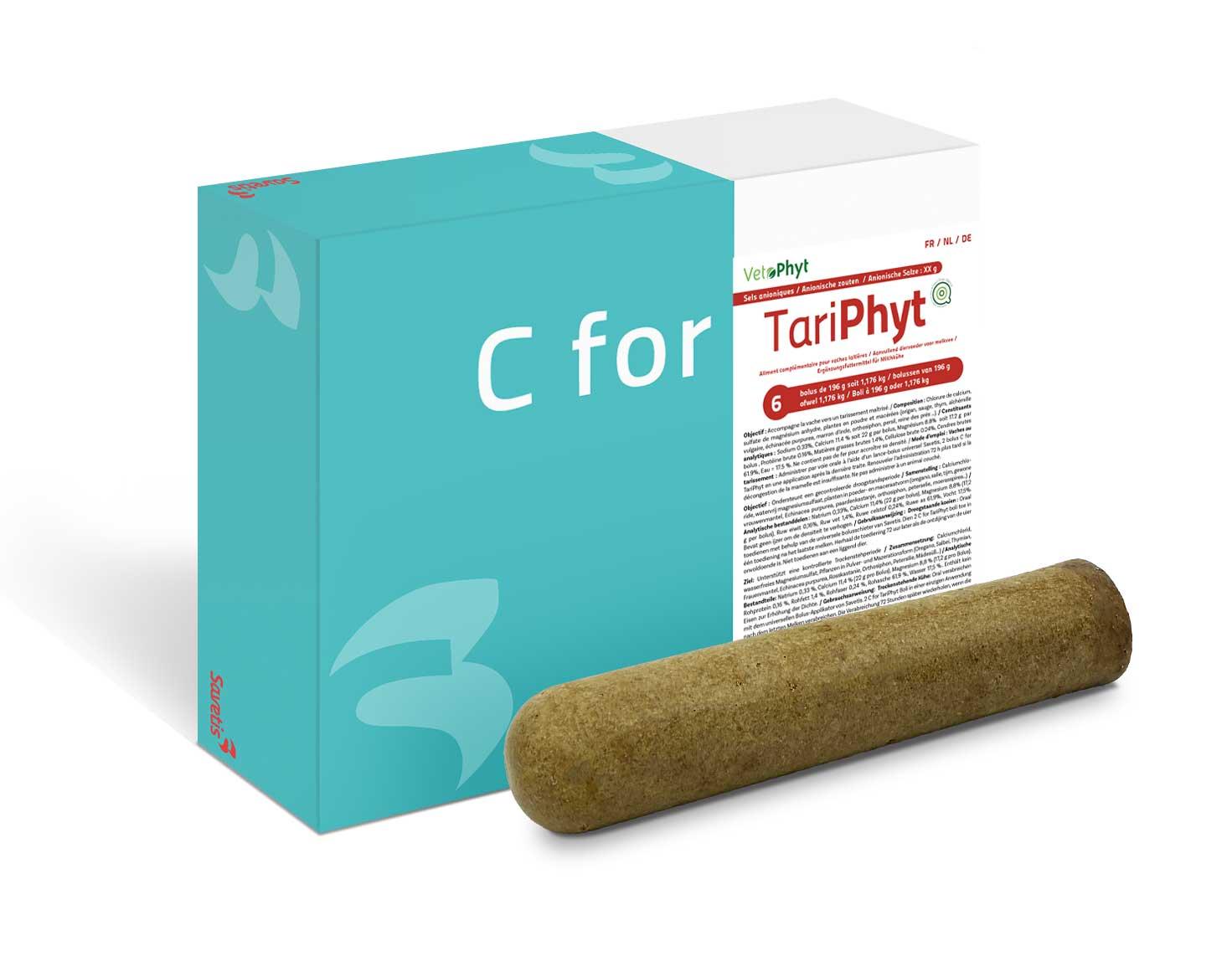
C for TariPhyt – Bolus mit anionischen Salzen und Pflanzen zur Begleitung des Trockenstellens
Empfohlen für
Ergänzungsfuttermittel für Milchkühe. C for TariPhyt begleitet die Kuh zu einem kontrollierten und physiologischen Trockenstellen. Es kombiniert anionische Salze, die das schrittweise Beenden der Laktation erleichtern, mit einer Auswahl an Pflanzen, die zum Komfort des Euters und zum Gleichgewicht des Organismus am Ende der Laktation beitragen.
Produktbeschreibung
Das Trockenstellen ist eine sensible Phase, besonders bei Kühen, die noch viel Milch geben. Ein zu volles Euter ist für das Tier unangenehm und verzögert die Involution des Euters. C for TariPhyt setzt an drei sich ergänzenden Punkten an.
Begleitung des schrittweisen Beendens der Laktation (1,2,3)
Jeder Bolus liefert 164 g anionische Salze, entsprechend einer DCAB von -2 460 mEq.
Gebrauchsanweisung
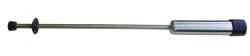
Beim Trockenstellen 2 Boli auf einmal unmittelbar nach dem letzten Melken mit einem universellen Savetis-Bolus-Eingeber verabreichen. Bei Bedarf die Verabreichung nach 72 Stunden wiederholen. Bolus mit 35 mm Durchmesser, zerfällt innerhalb von 2 Stunden.
Empfehlungen
Vor der Anwendung wird empfohlen, einen Tierarzt zu Rate zu ziehen. Nicht an liegende Tiere verabreichen. Vor Wärme und Feuchtigkeit geschützt bei 15 bis 25 °C lagern. Nach dem Öffnen rasch verbrauchen. Haltbarkeit: 24 Monate.
Präsentation
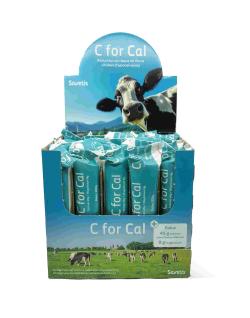
Bolus zu 196 g, in Schachteln zu 6 Boli.
Ausschließlich über Ihren Tierarzt erhältlich.
Literaturverzeichnis
(1) Maynou et al. (2018), Effects of oral administration of acidogenic boluses at dry-off on performance and behavior of dairy cattle, J. Dairy Sci. 101: 11342-11353.
(2) Florentino et al. (2024), Randomized clinical trial evaluating the effects of administration of acidogenic boluses at dry-off on udder health, milk yield, and herd removal, J. Dairy Sci. 107: 3899-3915.
(3) Brodin (2020), Étude des effets de l'administration de PRC-19 sur la diminution de la production laitière au tarissement chez des vaches laitières : éléments de bibliographie et de protocole.
(4) Ouvrier-Buffet (2017), Les plantes diurétiques à l'officine, Sciences pharmaceutiques, Dumas-01564248.
(5) Labre (2007), Phytothérapie & aromathérapie chez les ruminants et le cheval – Médecines naturelles en élevage, tome 2, Éditions Femenvet.
(6) Ottillinger & Greeske (2001), Rational therapy of chronic venous insufficiency – chances and limits of the therapeutic use of horse-chestnut seeds extract, BMC Cardiovasc. Disord. 1: 1-5.
(7) Felixsson et al. (2010), Horse chestnut extract contracts bovine vessels and affects human platelet aggregation through 5-HT2A receptors: an in vitro study, Phytother. Res. 24: 1297-1301.
(8) Arnould et al. (1996), Effect of aescine on hypoxia-induced activation of human endothelial cells, Eur. J. Pharmacol. 315: 227-233.
(9) Facino et al. (1995), Anti-elastase and anti-hyaluronidase activities of saponins and sapogenins from Hedera helix, Aesculus hippocastanum, and Ruscus aculeatus: factors contributing to their efficacy in the treatment of venous insufficiency, Arch. Pharm. 328: 720-724.
(10) Monographie Alchemilla vulgaris L. (2017), Myrtéa Formations.
(11) Boroja et al. (2018), The biological activities of roots and aerial parts of Alchemilla vulgaris L., S. Afr. J. Bot. 116: 175-184.
(12) Yadav et al. (2021), Combination therapy with Echinacea purpurea extract and quercetin is effective in hematological alterations in neonatal calf diarrhoea, The Pharma Journal.
(13) Pogany et al. (2010), Pseudomonads from rabbits and their sensitivity to antibiotics and natural antimicrobials, Res. Vet. Sci. 88(2): 203-207.
(14) Yakhlef et al. (2011), Évaluation de l'activité antimicrobienne de Thymus vulgaris et de Laurus nobilis, plantes utilisées en médecine traditionnelle, Phytothérapie 9(4): 209-218.
(15) Miura et al. (2002), Antioxidant activity of chemical components from sage (Salvia officinalis L.) and thyme (Thymus vulgaris L.) measured by the oil stability index method, J. Agric. Food Chem. 50(7): 1845-1851.
(16) Dapkevicius et al. (1998), Antioxidant activity of extracts obtained by different isolation procedures from some aromatic herbs grown in Lithuania, Journal of the Science of Food and Agriculture 77(1): 140-146.
andere Produkte der gleichen Kategorie